


 According to the NTSB accident report, they learned that the winds were changing direction and that a wind shear alert had sounded on the airport due to a thunderstorm nearby. ATC originally told them to expect Runway 22L for landing, but after the wind direction changed rapidly, Captain Buschmann requested a change to Runway 4R.
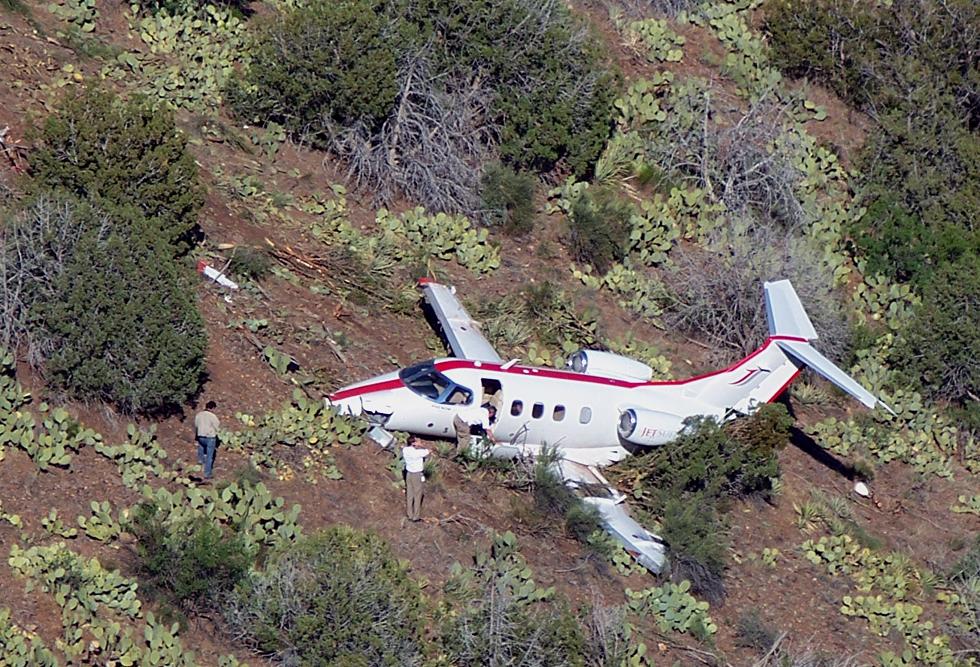 For at least the sixth time in more than a year, an Embraer Phenom 100 has experienced possible brake issues on landing. This latest instance occurred last Wednesday afternoon when a JetSuite-operated Phenom carrying three passengers and two crew left the runway while landing at Sedona (Ariz.) Airport, which is located on top of a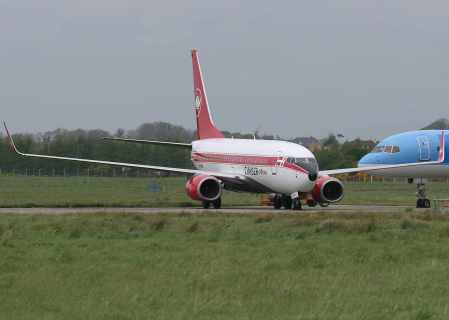


 .
.- Loading...
- No images or files uploaded yet.
Phenom 100 Damaged in Runway Departure
Cimber Sterling AT72 at Bornholm on Dec 16th 2010, runway excursionA Cimber Sterling Airlines Avions de Tranport Regional ATR-72-500, the airplane began to veer left and exited the edge of the runway coming to a stop with all gear off the paved surface nearly perpendicular to the runway.
More ‘Qs’ than ‘As’ in Teterboro accidentBy: Kirby J. Harrison
Aviation International News >> April 2005 Accidents
When a Challenger 600 operated by Platinum Jet Management overran the runway during an aborted takeoff at Teterboro Airport in February, crossed a busy highway and crashed into a warehouse, there was a collective sigh of relief when all eight passengers and the crew emerged with non-life-threatening injuries. Now that the wreckage has been hauled away, the airport boundary fence repaired and the NTSB has begun its investigation, the mystery of who, what and why is just beginning. • A motorist injured when the airplane struck his automobile has filed a $12.5 million notice of claim against the Port Authority of New York and New Jersey and a separate lawsuit against 11 other entities associated with the crash. • A passenger in the same car remains in a coma while lawyers wait in the wings. • The FAA has grounded Fort Lauderdale, Fla.-based Platinum Jet Management, saying it was operating illegally. • The agency has also approved a grant to install safety barriers at the end of the overrun. • Two other runway excursions at Teterboro–by a Hawker 700A on March 8 and a Beechjet on March 11–have added to the ire of anti-airport community groups. • Politicians representing a community actively hostile to the airport are making comments such as, “This airport just absolutely does not belong here.” • Unrelated, except by proximity, the FAA has issued a safety notice warning pilots departing Teterboro Airport to observe altitude requirements. The tempest at Teterboro began early on February 2 when the Challenger 600 rolled away from the Atlantic Aviation FBO with contract pilots John Kimberling and Carlos Winston Salaverria Jr. at the controls. A preliminary investigation by the Teterboro Flight Standards District Office (FSDO) indicates because it was carrying passengers for compensation and hire, the flight was covered by Part 135. In the back were “cabin aide” Angelica Calad-Gomez and eight passengers, members of Kelso Investments of New York City and their guests. New York City-based Blue Star Jets had booked the charter on behalf of Kelso. The Challenger had arrived from Las Vegas at about midnight on February 1 with a different crew. A source at Platinum Jet said both pilots for the morning flight met the applicable flight duty and rest requirements under FAA regulations. Calad-Gomez, commended by both pilots and passengers for her actions during and after the crash, was a relatively recent hire by Platinum Jet. She had not yet completed formal flight attendant training, said Platinum spokesman Randy Williams, but had gone through an in-house cabin safety program. And he added that because the flight was being conducted under Part 91 (contradicted by the Teterboro FSDO finding), a trained flight attendant was not required. Calad-Gomez was not listed on the manifest as a flight attendant. Williams said that during the engine run-up, “a test of the control surfaces [revealed that they] were normal.” Moments later, however, as the jet reached the rotation speed of about 135 knots, the pilot-in-command reported that there was only about an inch of movement when he pulled back on the yoke and that the airplane refused to fly. At about 145 knots, with both pilots pulling back on the yoke, Kimberling called an aborted takeoff, applying the brakes and deploying the spoilers and thrust reversers.
A United Parcel Service Boeing 767 Encounters Poor Visibility On Its Final Approach And Has Difficulty Slowing The Aircraft Down Upon Touch Down
Crash Report: Foiled by Faux Plastic WrapPosted byJohn Croft1:05 PM on May 24, 2013 German air investigators this week finally put the wraps on a February 2006 runway excursion of a Falcon 20 at the Kiel-Holtenau Airport in Northern Germany.
The only serious injury from the overshoot was to the 22 year-old Russian flight attendant, but it had nothing (and everything) to do with the crash. There were only minor injuries among the other souls on board – two pilots and three passengers – on the flight from Moscow Domodedovo Airport to London Luton. The aircraft, registered in France but operating “by a Russian business aviation company” did not fare as well, coming to rest 100 ft. past the end of the asphalt of the 4,130-ft.-long Runway 08 and 16 ft. down an embankment.
Based on the events that happened just prior, the outcome was very positive. According to the accident report, the Falcon had been in the air for 2.5 hours and cruising at Flight Level 380 (approximately 38,000 ft.). That’s when the pilots heard an “explosive bang” the cockpit voice recorder picked up an unusual sound for 4.19 seconds – a “sizzling sound” – which was followed by “screams … from the cabin”, which was followed by the flight attendant asking, “Where is the fire extinguisher?” German investigators later found out the source of the sizzling. The young flight attendant, whose training consisted of a three-month course in a Russian school for flight attendants and a total flying experience of 36 hours (with 3 hours in the past 90 days) was cleaning up the galley after meal service when the precipitating incident occurred. “The statement of the flight attendant indicates that while she was in the galley looking for a roll of plastic wrap she found the pyrotechnical device, unscrewed it, and inadvertently activated it,” the report states. She, unfortunately, received burns to her face and one hand. Pyrotechnical “device” in this case is putting it mildly – it was a handheld flare. “Powered by a solid fuel rocket it was meant to reach about 300 m (about 1,000 ft.) and let a red flare sink to the ground on a parachute for at least 40 seconds,” says the German Federal Bureau of Accident Investigation (BFU). “The device was meant to be used outdoors for the purpose of signaling an emergency. The manufacturer stated that the activated pyrotechnical device could be extinguished by water. According to the manufacturer the device has to be treated in accordance with the regulations for Dangerous Goods and it is not permitted to transport it in passenger aircraft.”
As you can imagine, things went from bad to worse, with the aircraft filled with smoke and black soot. When the altitude was low enough, the pilots opened a window to exhaust the smoke, but the resulting noise and overall stress level caused them to misinterpret the length of their diversion airport: The controller stated that the runway was 1,260 meters (4,133 ft.); the crew heard 2,600 meters (8,530 ft.), which is why they did not use thrust reversers on the landing rollout.
A340 veers off runway despite efforts to resist crosswinds
Compagnie Africaine Aviation B722 at Kinshasa
Accident: Compagnie Africaine Aviation B722 at Kinshasa on Jan 2nd 2010, veered off runway on landing By Simon Hradecky, created Saturday, Jan 2nd 2010 13:44Z, last updated Thursday, Jan 21st 2010 12:52Z
A Compagnie Africaine Aviation Boeing 727-200, registration 9Q-CAA performing a freight flight from Kinshasa to Kananga (Democratic Republic of Congo, RDC), suffered a hydraulics problem shortly after takeoff at approx 06:30L (05:30Z) prompting the crew to return to Kinshasa's Ndjili Airport. After touch down on Ndjili's runway 06 in heavy rain with water standing on the runway the airplane veered left off the runway and came to a stop with all gear collapsed and turned around by about 135 degrees at 08:00L (07:00Z). No injuries occured, the airplane received substantial damage. RDC's Directorate General of Civil Aviation reported on Jan 6th, that the hydraulics leak with the hydraulics quantity rapidly approaching zero affected the brakes, so that the captain (68) got concerned about the ability to stop the airplane in Kananga and therefore decided to return to the longer runway at Ndjili. After touch down, the airplane could not be slowed due to a brakes failure. The left hand main gear separated having the airplane veer left off the runway, the right hand main gear collapsed throwing the airplane into a "pirouette" separating the nose gear. A source within the airline reported on Jan 21st, that the airplane had suffered a tailskid strike on Dec 31st 2009 during takeoff from Goma (RDC) for Kinshasa, when a combination of tailwind and overload forced the crew to rotate at V1 and below Vr because of reaching the runway end. After arrival in Kinshasa the tailskid was checked, but was not replaced.
More picsExcursion in Nepal
Read about it on the Aviation Herald
After landing in Navegantes
Read about it on Aviation Safety Network
Veered off in SBPV
Read about it on Aviation Herald
Veered off in Galeão
Read about it on Aviation Herald (or on Terra in Portuguese with more pics) Veered off in Congonhas
Overran in Congonhas
Overran in snow
Couldn't stop
Couldn't stop either
In the draining system
Veered off in the snow
A siteA cool site to see more of these runway excursions.
..
|
|

Comments (0)
You don't have permission to comment on this page.